
Major Indian carmakers are preparing for sluggish domestic PV sales growth of just 1-2 per cent in FY26.

The wholesale price-based inflation rose to a four-month high of 14.55 per cent in March, mainly due to hardening of crude oil and commodity prices, even though vegetables witnessed easing of price pressures. As per the government data released on Monday, WPI inflation has remained in double digits for the 12th consecutive month beginning April 2021. The last time such a level of WPI was recorded was in November 2021, when inflation was 14.87 per cent.

The government on Saturday imposed a 40 per cent duty on the export of onions to increase domestic availability amid signs of increasing prices. The export duty, which is the first time ever on onion, has been imposed as the retail sale price of the kitchen staple, according to government data, touched Rs 37/kg on Saturday in Delhi. The finance ministry through a Customs notification imposed a 40 per cent export duty on onions till December 31, 2023.

The good news on inflation continues as the wholesale price index fell for the tenth week in a row to an almost 11-month low of 5.24 per cent for the week ended January 3, prompting the Finance Ministry to project that it would go down to 3-4 per cent by March 31.

In November, wholesale prices, India's main inflation measure, rose 7.52 percent, their fastest pace in 14 months.

The wholesale price-based inflation rose to 2.03 per cent in January, 2021, even as food prices cooled. The WPI inflation was 1.22 per cent in December, 2020 and 3.52 per cent in January last year. While food articles saw softening in inflation in January, manufactured items witnessed hardening of prices, as per data released by the Commerce and Industry ministry.
Chief economic adviser to the finance ministry Arvind Virmani on Wednesday said the retail price-based inflation, which is ruling above the wholesale price index, will come down with a lag but would not fall as much as the rate of rise in wholesale prices is falling.
Data late on Wednesday showed consumer price inflation eased more than-expected to a 25-month low of 8.10 per cent in February, while industrial output unexpectedly expanded, albeit only by 0.1 per cent.
After rising for five consecutive weeks, inflation fell to 5.09 per cent during the week ended October 28, compared to 5.41 per cent in the previous week with drop in prices of essential commodities.\n\n

The wholesale price-based inflation spiked to 12.54 per cent in October, mainly due to rise in prices of manufactured products and crude petroleum. WPI inflation has remained in double digit for the seventh consecutive month beginning April. Inflation in September this year was at 10.66 per cent, while in October 2020 it was at 1.31 per cent.

Industrial ouput, however, was seen falling 0.6 per cent in January

If the pattern over the last three months is going to continue, the likelihood is that both indices will register inflation rates close to current levels over the next few months.

Inflation in onion continued to rule high at 42.22 per cent and in potato at 43.25 per cent.

Consumer prices were forecast to have risen 10.00 per cent annually last month, barely changed from the 10.09 per cent clocked in October.

Retail inflation in March inched up to 8.31 per cent from 8.03 in February, mainly on account of a rise in fruit and vegetable prices.

We have not suffered such huge price shocks across so many basic commodities, at the same time, in decades. Has the inflationary impact of all this been factored into stock prices as yet, asks Debashis Basu.
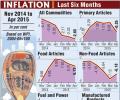
The deflationary trend has bolstered the case for a rate cut by RBI.

The wholesale price-based inflation hovered over seven per cent through 2012, down from 10 per cent inflation seen in the previous year, reflecting the impact of tight money policy of the Reserve Bank of India.

Analysts expect inflation to peak in the first half of 2016-17 and moderate, thereafter, on the back of positive impact of monsoons
Even as the government grapples with a surge in prices, a three-year old initiative to recast the index that measures wholesale prices is not getting anywhere fast. The revised index is likely to take at least another year to implement and may spill over into the tenure of the next government.

In a data-packed week, the domestic macroeconomic figures -- industrial production and inflation numbers -- along with global trends would dictate trends in the equity market this week, analysts said. According to experts, markets may face volatile trends due to high valuations. Equity benchmark indices Sensex and Nifty hit their fresh record peaks on Thursday. Besides, trading activity of foreign investors, movement of global oil benchmark Brent crude and rupee-dollar trend would also influence trading in equities.
Inflation declined to 5.30 per cent for the week ended November 25 from 5.45 per cent in the previous week, mainly because of fall in the prices of food items.

Snapping the two-month easing trend, WPI inflation rose in August and remained in double-digit for the fifth consecutive month. In July 2021, WPI inflation stood at 11.16 per cent. In August 2020, WPI inflation was at 0.41 per cent. "The high rate of inflation in August 2021 is primarily due to rise in prices of non-food articles, mineral oils; crude petroleum and natural gas; manufactured products like basic metals; food products; textiles; chemicals and chemical products etc as compared the corresponding month of the previous year," the commerce and industry ministry said in a statement.

'There are occasions when the prices of individual items like food raise inflation; then supply-side measures must be taken.' 'But if there is continued inflation, it means liquidity is aggravating the situation.'
For the first time since the new wholesale price index\nseries started in 1995, India's annual rate of inflation turned negative, falling to\nminus 1.61 per cent for the week ended on June 6.

The rise in May Wholesale Price Index based inflation has been mainly on account of 31.44 per cent increase in prices of potato, 19.40 per cent in fruits and 12.75 per cent in rice.
Inflation declines to 8.00 per cent for the week ended November 29 from 8.40 per cent in the previous week.

Spiralling prices pinched the pocket of consumer as edible oil, fuel and many other commodities turned dearer this year amid pandemic-induced disruptions but the inflationary pressure is anticipated to ease, though marginally, in the coming months. As consumers, at retail as well as wholesale levels, are willy-nilly learning to live with the new normal of curbs to contain the spread of coronavirus infections, experts are of the view that elevated inflation is likely to stay longer. After dealing with the devastating blows from the second COVID wave, especially during the April-June period, the economy is well on the revival path but the emergence of Omicron might unsettle the recovery trajectory in the short term.
Higher prices of food products and some manufactured items pushed up inflation to 3.21 per cent for the week ended November 17, against 3.01 per cent a week ago.

Inflation in food articles was at 0.87 per cent in April 2018, as against a deflation of 0.29 per cent in the preceding month.
WPI-based inflation falls to 5-month low of 6.16%.

Inflation in pulses, vegetables and cereals was higher in Jan.

India's annual rate of inflation, based on its monthly Wholesale Price Index, climbed to 6.01 per cent for the month of May 2014, as against 5.20 per cent for May and 4.58 per cent during the corresponding month of the previous year, which has set off alarm bells.
The government's efforts to bring down inflation to tolerable limits and curb runaway prices might have begun to bear some fruit.
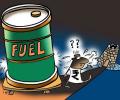
The wholesale price-based inflation accelerated to a record high of 12.94 per cent in May, on rising prices of crude oil and manufactured goods. Low base effect also contributed to the spike in WPI inflation in May 2021. In May 2020, WPI inflation was at (-) 3.37 per cent. This is the fifth straight month of uptick seen in the wholesale price index (WPI)-based inflation. In April, 2021, WPI inflation hit double digit at 10.49 per cent. "The annual rate of inflation, based on monthly WPI, was 12.94 per cent for the month of May, 2021 (over May, 2020) as compared to (-) 3.37 per cent in May 2020.

The wholesale price-based inflation had shot passed 10 per cent in May putting more pressure on the Central Bank to hike the policy rates.
Core inflation, a measure of demand-side pressure on prices also rose sharply in March.
RBI might retain rates at current levels, upside risks to inflation rise.

Indian households database Consumer Pyramids answers why two years of high inflation did not matter to the consumers of the country.
 © 2026 Rediff.com - Advertise with us - Disclaimer - Privacy Policy - Sitemap - Feedback - About us - Terms of use - Grievances